Kids, Teens & Families
Blue light glasses for online schooling and homework
Quick answer
For online lessons and homework, a good setup matters more than any glasses: the screen raised to near eye level, a chair at the right height and a lamp on. If you do buy a pair, choose clear lenses so worksheets look normal, in a frame tough enough for the school bag.
Do children need special glasses for online school or homework?
No. Children can do online lessons and homework perfectly well without them. Blue light glasses are an optional comfort extra, and the setup of the homework space makes a bigger practical difference.
Where a pair can help is small but real. The anti-glare coating cuts reflections from a window or ceiling light on a shiny laptop, and the lenses filter blue light from the screen. Some children also find that putting their glasses on is a handy signal that homework has started.
If you decide to buy, our kids' range has clear-lens frames sized for smaller faces, and teenagers are usually better suited to small adult frames.
How should you set up a homework space?
Put the screen at roughly eye level, the chair at a height where feet can rest flat, and make sure the room is not lit only by the screen. None of that needs special furniture.
A laptop flat on the kitchen table means a child spends the whole session looking down. A stack of books or a cheap stand under the laptop, with a separate keyboard if you have one, fixes that in minutes. Our post on getting your screen setup right goes into more detail for adults, and most of it applies to children too.
- Raise the laptop or tablet so the top of the screen is near eye level
- Feet flat on the floor, or on a box or footrest
- A lamp on in the room, not pointed straight at the screen
- Screen side-on to a window rather than facing or backing onto it
- Keep the desk clear enough for books and paper as well as the device
- The same spot every day, so homework has a home
Why clear lenses suit schoolwork best
Because homework moves between a screen and paper all the time, and clear lenses keep both looking normal. A tinted lens gives white paper a yellow cast and changes how highlighter pens and coloured diagrams look, which is unhelpful when a task depends on colour.
Clear lenses also look like ordinary glasses on a class video call, and they will not draw comments at school if the same pair travels in a school bag. Amber or orange tints are better kept for gaming at home, if at all.
Every frame in our kids' range uses clear lenses that filter blue light from screens and cut glare, so there is no wrong lens choice to make.
For art homework, science diagrams or anything involving colour-matching, it can be worth doing that part without any glasses at all if your child does not normally wear them. Clear lenses keep colours looking normal, but simple is best when the task is all about colour.
Which frames survive the school bag?
A flexible frame, or a metal front with soft sleeves, plus a case. Homework glasses spend most of their life in a bag with a water bottle, a lunchbox and a PE kit.
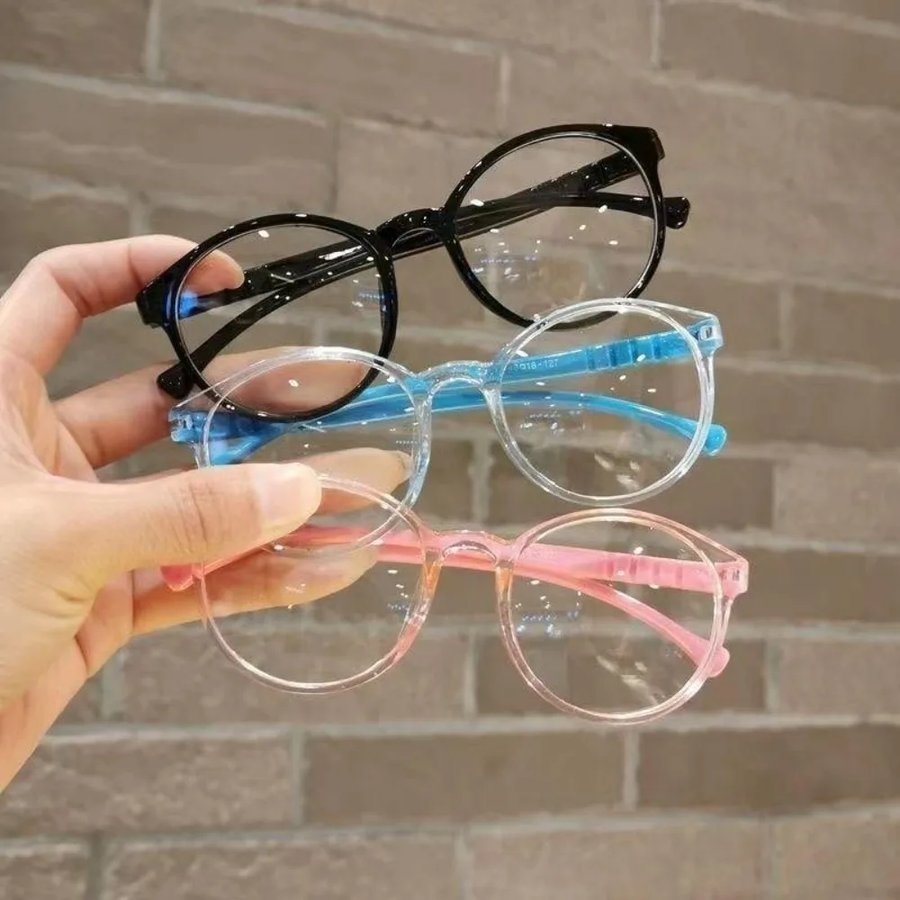
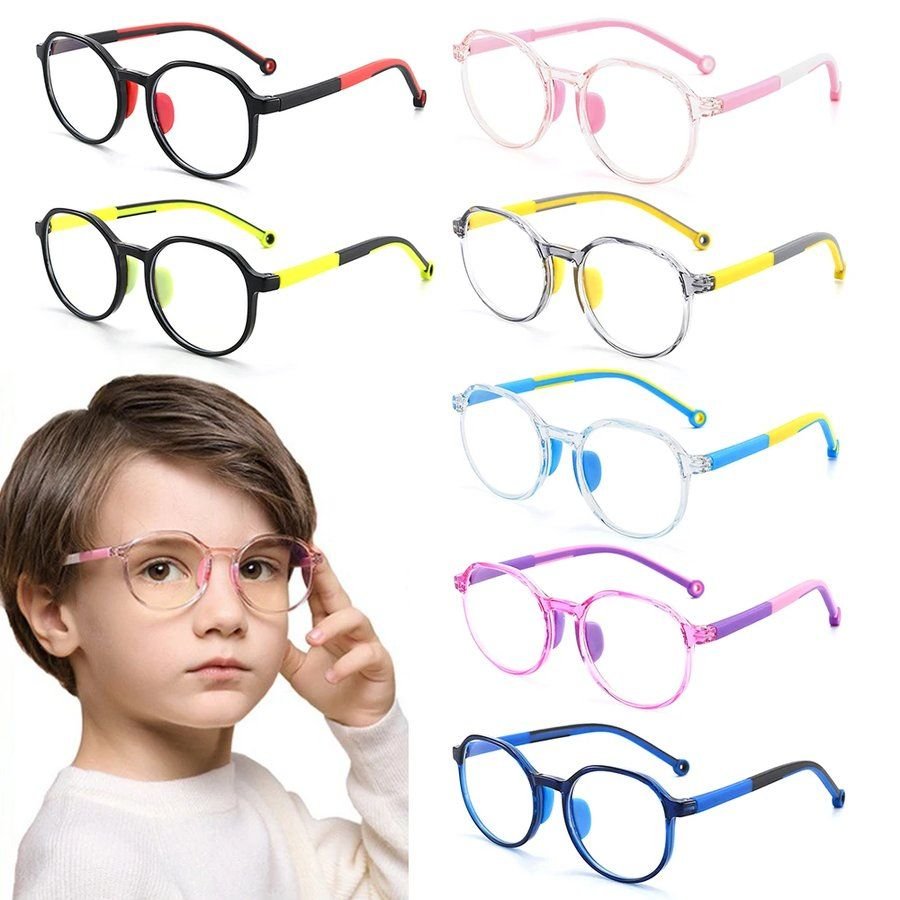
The Kids Flexi (£9.99) is a soft, bendy round designed to cope with being sat on and stuffed into book bags. The Kids Colour-Pop (£11.99) is a flexible TR90 round with silicone nose pads, in seven colour combinations.
At these prices, some families buy two: one that stays at the homework desk and one that travels. That also means a pair left at school does not stop homework happening at home.
Glare, reflections and class video calls
An anti-glare coating cuts reflections on the lens, which is the part of a video call a child and their teacher will actually notice. Without it, a lamp or a bright window can show up as a white patch over the eyes on camera.
Positioning helps as much as the lens. Sitting side-on to a window, with a lamp slightly in front rather than behind, gives a clearer picture and fewer reflections on both the screen and the glasses.
It is also worth checking the camera angle. A laptop raised on books puts the camera closer to eye level, so the teacher sees a face rather than a ceiling.
A quick test before the first lesson saves a lot of fiddling later. Open the camera, look at the preview with glasses on, and move the lamp or the laptop until the white patches on the lenses disappear.
Homework routines that stick
The routines that last are simple and predictable. Children settle into homework more easily when it happens at the same time, in the same place, with the same start and finish.
A visible finish line helps as well. Agreeing what 'done' looks like before starting, such as one worksheet and ten minutes of reading, stops homework from drifting into an evening of half-finished tasks and open browser tabs.
Our post on managing family screen time covers how to agree screen rules as a household, and the same approach works for homework.
- Homework first, then games or videos
- Close unrelated tabs and apps before starting
- Phones in another room while working, for older children
- Short breaks to stretch, get a drink or look out of the window
- Laptop back in its shared spot when the work is done
When is it time to book an eye test instead?
Whenever you have any doubt at all. If your child is squinting at the board, holding books very close, losing their place when reading, or a teacher mentions something, that is a question for an optician, not a reason to buy blue light glasses.
If anything about your eyes worries you, book an eye test with an optician. NHS sight tests are free for under-16s in the UK, and many families book one before each new school year as a matter of routine.
If your child turns out to need prescription glasses, lenses that filter blue light can be added to a prescription pair. Our kids' frames are non-prescription.
For older students revising on laptops, see our page on blue light glasses for students. Not sure which frame your child will wear? Our Home Try-On sends up to four frames for seven days, free.
Frequently asked
Do kids need blue light glasses for online school?
No, they are an optional extra. A screen at the right height, a sensible chair and good room lighting make a bigger practical difference. If you buy a pair, choose clear lenses in a durable frame.
Should children's homework glasses have clear or tinted lenses?
Clear lenses are the better choice for homework. Schoolwork switches between screens and paper, and a tint makes white paper look yellow and changes how colours look.
How high should a laptop be for a child doing homework?
Aim for the top of the screen to be close to eye level when they sit up straight. A stack of books or a simple laptop stand is enough, with a separate keyboard if you have one.
Can my child wear blue light glasses on school video calls?
Yes. Clear lenses with an anti-glare coating look like ordinary glasses on camera and cut reflections from lamps and windows. Sitting side-on to a window helps too.
My child is squinting at the screen. Should I buy blue light glasses?
Book an eye test with an optician first. NHS sight tests are free for under-16s in the UK, and an optician can tell you whether your child needs glasses of any kind.
What are the most durable glasses for school?
Flexible frames that bend back into shape, or metal fronts with soft arm sleeves, kept in a hard case. Most breakages happen in a school bag, so the case matters as much as the frame.
Mentioned above
Frames from this guide
Kids, Teens & Families
More from this topic
Blue light glasses for kids: what parents should know
Kids' blue light glasses are child-sized frames with lenses that filter blue light from screens and cut glare. They are.
Read Kids, Teens & FamiliesBlue light glasses for teens and gaming
Most teenagers need a small adult frame rather than a kids' one, and they care a lot about how it looks. For school and.
Read Kids, Teens & FamiliesManaging family screen time
Family screen time is easiest to manage with a few simple household agreements about where and when devices are used.
Read