Styles, Frames & Face Shapes
Square blue light glasses
Quick answer
Square blue light glasses add structure to a face. Clean horizontal lines and defined corners give round and oval faces the definition they lack, which makes the square the most reliably flattering shape for the widest range of people. They also read clearly on webcams, which is why they are so popular for desk work and streaming.
Why are square frames such a safe default?
Square frames suit the widest range of faces and settings, so if you had to recommend one shape without seeing someone's face, it would be a square.
They suit round faces by contrast, oval faces because ovals suit nearly everything, and heart-shaped faces when the corners are softened slightly. They look at home in an office, a classroom, a stream or a pub. That ubiquity has a downside: a plain black square is about the least distinctive thing you can put on your face. Whether that is a problem depends on what you want your glasses to do. For many people buying their first pair of screen glasses, blending in is exactly the brief.
Who do square glasses suit?
Square glasses suit round and oval faces best. They are less obviously right on a face that is already strongly square or rectangular, where they repeat the existing angles.
The straight top bar and defined corners of a square frame add the lines a round face does not have, so the face looks more structured. Oval faces carry squares easily. For a square face with a broad jaw, a hard-edged square can make the whole face look blocky, though a softened square with rounded corners bridges the gap well. Heart-shaped faces often suit a square with a slightly lighter lower rim, which keeps attention near the brow without adding weight at the chin.
- Round faces: adds structure and definition
- Oval faces: an easy, balanced match
- Heart-shaped faces: choose a lighter lower rim
- Square faces: pick softened corners or try a round
- Long faces: choose a deeper square over a shallow one
How deep should square frames be?
Square frames vary a lot in depth, and depth changes the whole look. Shallow, wide squares read modern and technical; deep, near-cubic squares read bolder and more fashion-led.
Both are current, but they say different things. A shallow square keeps a low profile and suits people who want their glasses to sit quietly under the brow. A deeper square covers more of the face, adds presence and suits longer faces, because the extra depth breaks up the length. On a smaller face, very deep squares can look heavy, and compact versions tend to sit better; our fit guide for small and narrow faces explains how to read frame sizes.
How should square glasses fit?
A square frame should sit within the width of your face, with the top rim roughly following your brow line rather than cutting across your eyebrows.
Because a square has a strong top bar, where that bar sits is very visible. Too high and the frame floats above the face; too low and it hides your eyebrows, which carry a lot of expression. Your eyes should sit near the centre of each lens. The corners should not dig into your cheeks when you smile, and the arms should run straight back to your ears. If the frame slides when you look down at your phone, it is likely too wide at the bridge.
- Frame width within your face width
- Top bar following, not covering, the brow line
- Eyes near the centre of each lens
- Corners clear of the cheeks when you smile
- No sliding when you look down
Why do streamers and desk workers pick square frames?
Square frames survive a webcam. Video compression softens edges, and a square has edges to spare, so the frame keeps its outline where a thin round wire can disappear.
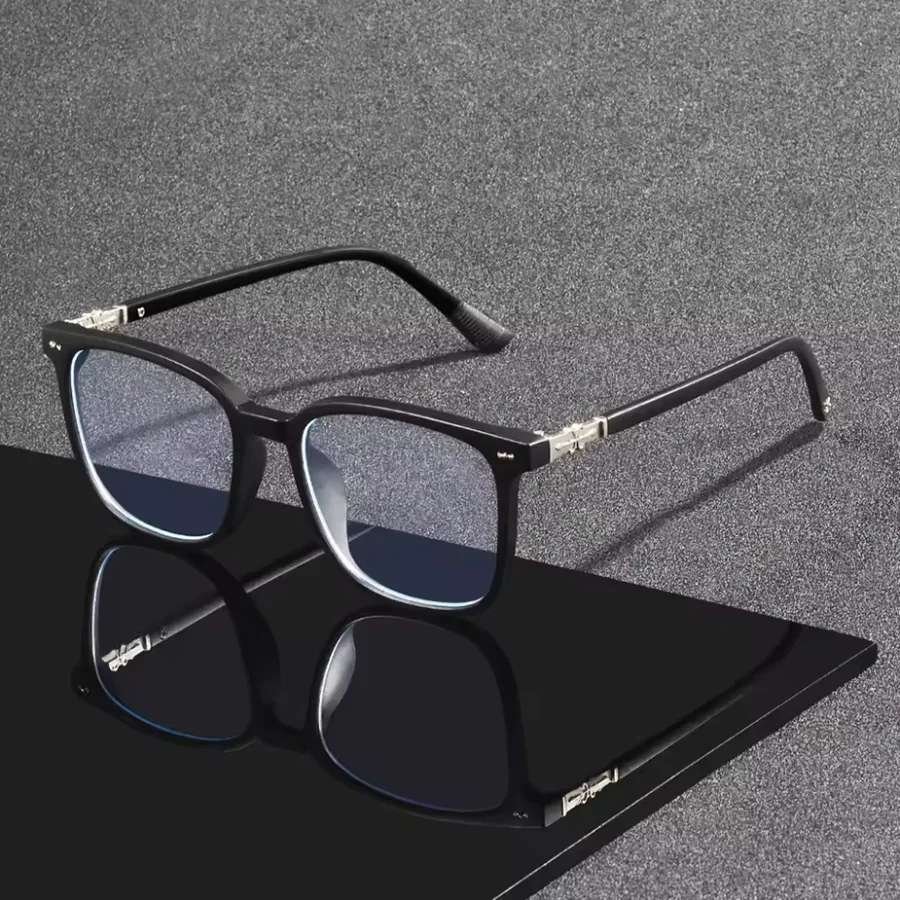
A defined top bar in a dark colour reads clearly even at modest camera resolutions, which is why so much gaming and office eyewear defaults to the square. Squares with a slim arm also tend to sit comfortably under a headset. The Midnight Square Blue Light Glasses at £9.99 are a matte black example built with that in mind. On the practical side, our lenses filter blue light from screens and the anti-glare coating cuts reflections from monitors and ring lights, whichever square you choose.
Which colour of square frame should you choose?
Black is the classic, slate and grey are softer versions of the same idea, and clear squares give you the shape without the heavy outline.
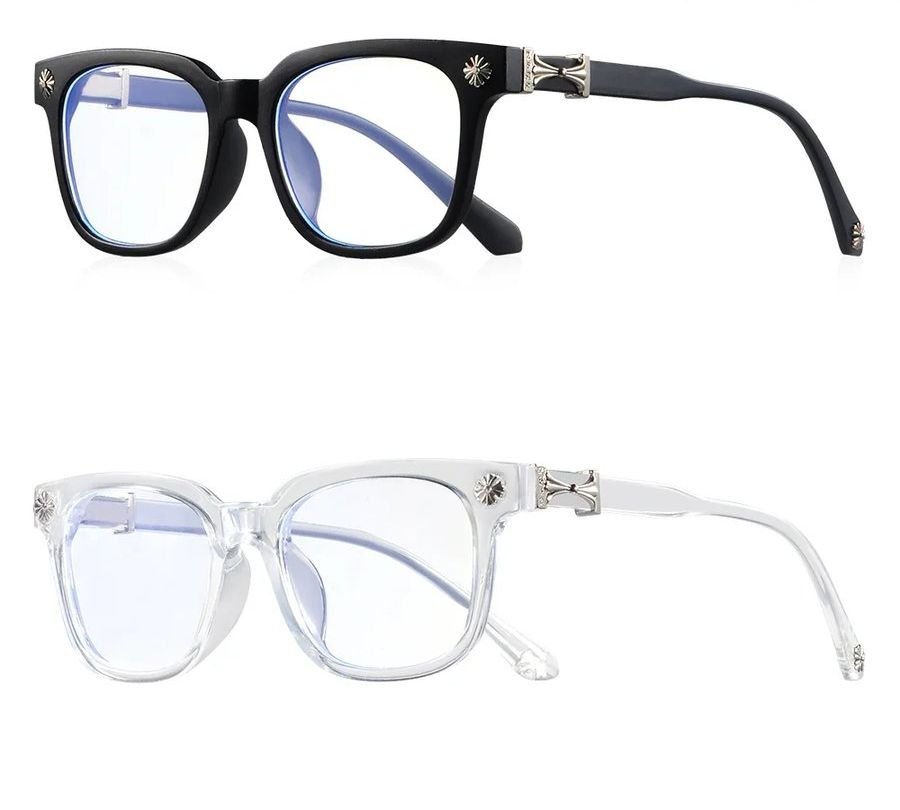
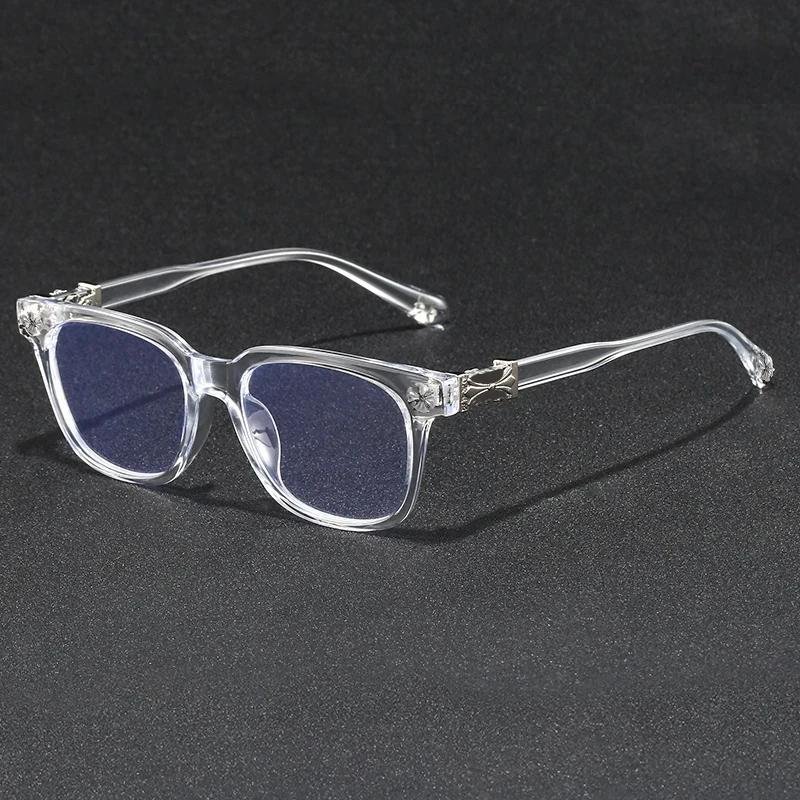
Matte black is the most versatile and the best on camera. Slate grey, like the Slate Square Blue Light Glasses, is a little gentler against lighter hair and skin tones. Tortoiseshell adds warmth and pattern, which softens the geometry of a square. Clear squares look modern and suit anyone who finds a black frame too severe. If you cannot decide, the Studio Square Twin Pack includes one black and one clear frame for £12.99.
Square or rectangle: which is better?
Choose a square if you want more presence and a current look; choose a rectangle if you want something lower-profile and more conservative.
Rectangles are noticeably wider than they are deep, so they sit in a slimmer band across the face. Squares are closer to equal proportions and have more visual weight. On a round face both add definition, but the square does it more strongly. On a long face, a square is usually the better of the two, because its depth breaks up length. If you have a square jaw and want something softer entirely, round frames are worth a look.
Budget is rarely the deciding factor here, because both shapes are available at similar prices across our range. Think instead about how you use your glasses. If they are mostly for long desk days and calls, a square with a slim arm and a matte finish is hard to beat. If you want them to stay low-key in a formal workplace, a slim rectangle is the quieter option. And if you simply cannot choose, trying both side by side at home settles it in about thirty seconds.
Browse the full square frames collection and try up to four styles free for seven days with Home Try-On. For how squares compare with every other shape, see our frame shapes and face shapes guide.
Frequently asked
What face shape suits square glasses?
Round and oval faces suit square glasses best, because the straight lines add structure. Heart-shaped faces also do well with a square that has a lighter lower rim.
Do square glasses suit a square face?
Hard-edged squares can make a square face look blocky. A softened square with rounded corners works better, or try round and oval frames for contrast.
Are square glasses good for a round face?
Yes, they are one of the best choices. The defined corners and straight top bar give a round face the definition it naturally lacks.
What is the difference between square and rectangle glasses?
Rectangle frames are noticeably wider than they are deep and sit lower profile. Square frames are closer to equal width and depth, with more presence.
Are square glasses good on camera?
Yes. A defined dark square keeps its outline through webcam compression, which is why square frames are popular with streamers and people on video calls.
Are square glasses unisex?
Yes. Square frames are worn widely by everyone, and colour, depth and rim thickness change the look far more than who is wearing them.
Mentioned above
Frames from this guide
Styles, Frames & Face Shapes
More from this topic
Round blue light glasses: who they suit
Round blue light glasses suit faces with defined angles. Square, rectangular and heart-shaped faces get the most from.
Read Styles, Frames & Face ShapesOval blue light glasses styling
Oval blue light glasses are the gentlest frame shape: a soft, slightly horizontal lens with no corners. They suit.
Read Styles, Frames & Face ShapesCat-eye blue light glasses
Cat-eye blue light glasses lift at the outer corner, drawing attention upward and adding definition at the cheekbone.
Read