Styles, Frames & Face Shapes
Round blue light glasses: who they suit
Quick answer
Round blue light glasses suit faces with defined angles. Square, rectangular and heart-shaped faces get the most from them, because the curve softens a strong jaw or brow. Oval faces wear them easily too. On a very round face they can repeat the curve, so a larger size and a slimmer rim help.
Who do round blue light glasses suit?
Round frames suit people whose faces have corners. If your jaw is broad and defined, your brow is strong or your cheekbones are sharp, a round lens adds the curve your bone structure does not have, and the result looks balanced rather than harsh.
In practice that means square and rectangular faces first, heart-shaped faces second and oval faces almost always. It is also one of the most genuinely unisex shapes in eyewear: the same round frame reads bookish on one person, relaxed on another and a little rock-and-roll on a third, depending mostly on colour and rim thickness rather than who is wearing it.
- Square faces: the curve softens a broad jaw
- Rectangular faces: the round lens breaks up long straight lines
- Heart-shaped faces: a round lens balances a narrower chin
- Oval faces: balanced proportions carry almost any round
- Round faces: possible, but choose size and rim carefully
Why does the contrast rule work?
Frame choice mostly comes down to contrast. A shape that differs from your face creates a counterpoint that looks deliberate, while a shape that copies your face tends to exaggerate what is already there.
A round lens against a square jaw is the classic example. The eye reads two different shapes and settles on the balance between them. Put the same round lens on round cheeks and the two curves echo each other, which can make the lower half of the face look fuller. None of this is a law, and plenty of people break it happily, but it explains why a frame that looks perfect on a friend can feel slightly off on you. It is also the principle behind every other shape guide on this site, so once it clicks you can apply it anywhere.
Can you wear round glasses with a round face?
Yes, with a couple of adjustments. The combination that struggles is a small, thin, perfectly circular frame on a soft, wide face, because it looks undersized and repeats the curve twice.
Three things make it work. Go slightly larger, so the frame reaches the outer edge of your cheekbones rather than sitting inside them. Choose a frame with a little structure, such as a keyhole bridge or a flatter top edge, which adds an angle without abandoning the shape. And pick a darker or patterned colour, which gives the frame more definition than a pale metal. If you are torn, an oval frame is the halfway house: the same softness, a little more width.
How should round glasses fit?
A round frame should be roughly as wide as the widest part of your face and no wider. Too small and it looks like a costume choice; too large and it takes over.
Round frames are also the shape most prone to sliding, because the lens has no corners to rest against the cheek and brow. The bridge does most of the work, so pay attention to how it sits. Keyhole and saddle bridges spread the weight across the nose and suit round lenses particularly well. Your pupils should sit close to the centre of each lens, and the top of the rim should follow or sit just under your eyebrows rather than cutting through them.
- Frame width about equal to the widest part of your face
- Pupils roughly centred in each lens
- Top rim at or just below the brow line
- No red marks on the nose after an hour of wear
- Arms resting lightly over the ears, not pressing
Metal or acetate: which round frame should you choose?
Metal rounds are lighter and quieter; acetate rounds have more presence and warmer colour. Both filter blue light from screens in the same way, because the filter lives in the lens, not the frame.
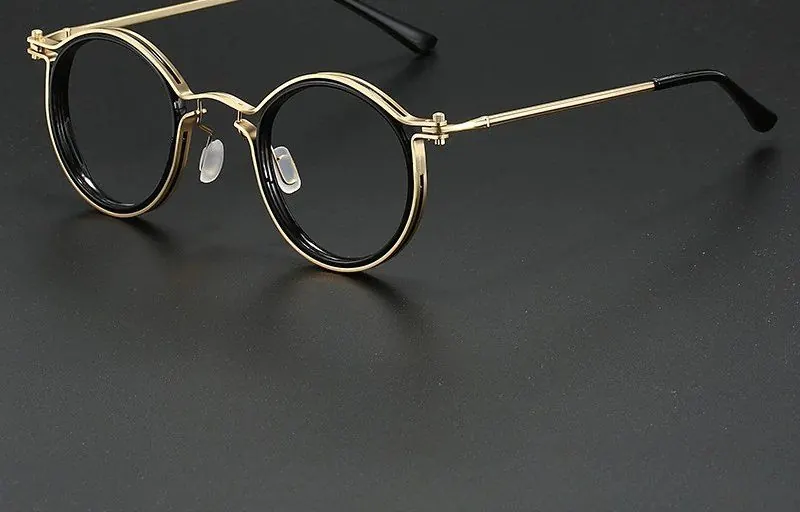
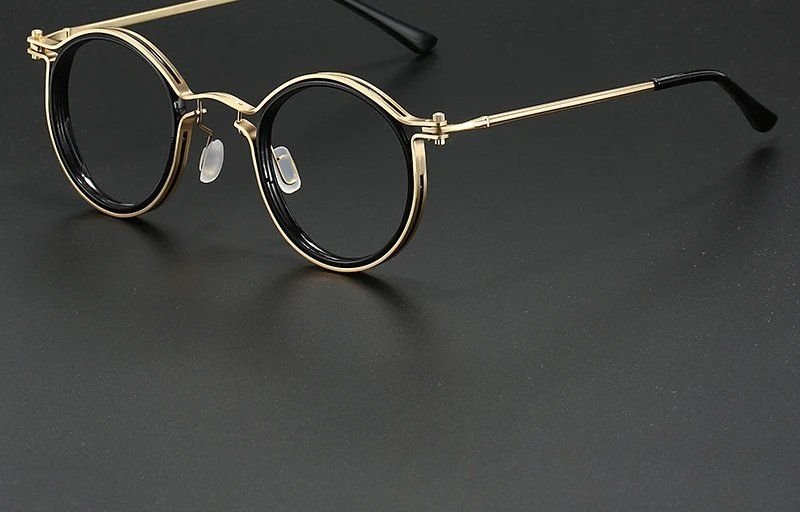
A thin metal round reads intellectual and understated, and it suits people who want glasses to be part of the face rather than an accessory. Something like the Black and Gold Round Blue Light Readers sits in that camp. Acetate rounds, such as the Cocoa Round Blue Light Glasses at £9.99, feel softer and more fashion-led, and the thicker rim gives a round face a little extra definition. If weight over a long desk day matters most to you, the Featherlight Round is named for exactly that reason.
Which colours work best in a round frame?
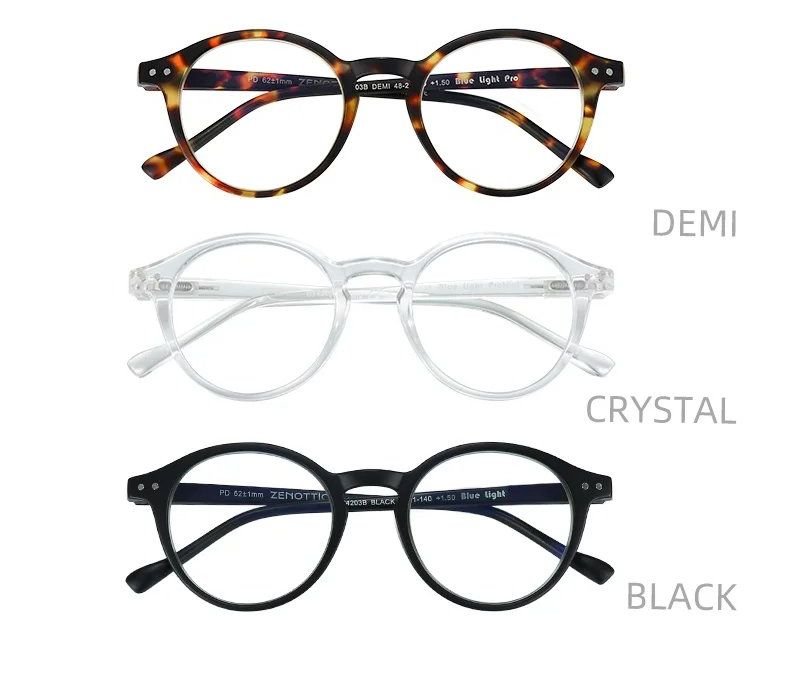
Tortoiseshell is the safest colour in a round frame. The pattern breaks up what is otherwise a very simple shape and flatters most skin tones.
Black gives a round frame a graphic, slightly retro look and adds the most definition, which helps if your face is on the softer side. Warm browns and cocoa tones are gentler and suit anyone who finds black too severe. Gold and silver metals keep the frame light and work well with jewellery. Clear and crystal rounds are the least visible option and suit people who want the shape without the outline.
- Tortoiseshell: the most forgiving all-rounder
- Black: most definition, most graphic
- Cocoa and brown: softer, warmer, easy to wear daily
- Gold or silver metal: light and understated
- Clear: the shape without a hard outline
Are round glasses a good choice for screens, work and video calls?
Yes. Round frames have gone in and out of fashion for about a century, so they rarely look dated in an office, and a mid-sized round gives a comfortable spread of lens in front of a monitor.
On camera, a slim metal round can fade into the background under bright lighting, which some people like and some do not. If you are on calls all day and want your glasses to read clearly, a darker acetate round holds its outline better on a webcam. Whatever you choose, the lens is what does the practical work: our lenses filter blue light from screens and the anti-glare coating cuts reflections from overhead lights and windows.
Not sure between two rounds? Order up to four frames through Home Try-On, free for seven days, and compare them in your own mirror and on your own webcam. Browse the full round frames collection, or read our guide to frame shapes and face shapes for the bigger picture.
Frequently asked
Do round glasses suit a round face?
They can, but they are the trickiest combination. Choose a slightly larger round with some structure, such as a keyhole bridge or darker rim, or consider an angular frame, which gives a round face more definition.
What face shape suits round glasses best?
Square and rectangular faces get the most from round frames, because the curve softens a strong jaw and brow. Heart-shaped and oval faces also wear them well.
Are round glasses unisex?
Yes. Round is one of the most genuinely unisex frame shapes. Colour and rim thickness change the look far more than who is wearing them.
Are round glasses still in fashion in 2026?
Round frames have moved in and out of fashion for decades without ever looking truly dated. Tortoiseshell acetate and thin metal rounds are both widely worn right now.
Should round glasses be bigger than my face?
No. Aim for a frame roughly as wide as the widest part of your face. A round frame that extends past it tends to look oversized rather than intentional.
Why do my round glasses keep slipping?
Round lenses have no corners to rest against the cheek or brow, so the bridge carries the fit. A keyhole or saddle bridge, or a gentle arm adjustment, usually helps.
Mentioned above
Frames from this guide

Styles, Frames & Face Shapes
More from this topic
Oval blue light glasses styling
Oval blue light glasses are the gentlest frame shape: a soft, slightly horizontal lens with no corners. They suit.
Read Styles, Frames & Face ShapesCat-eye blue light glasses
Cat-eye blue light glasses lift at the outer corner, drawing attention upward and adding definition at the cheekbone.
Read Styles, Frames & Face ShapesBlue light glasses for small and narrow faces: a UK fit guide
For a small or narrow face, choose blue light glasses with a smaller total width, a lens that suits your proportions.
Read